Do nothing. Win: The US, China, and 21st Century Global Power

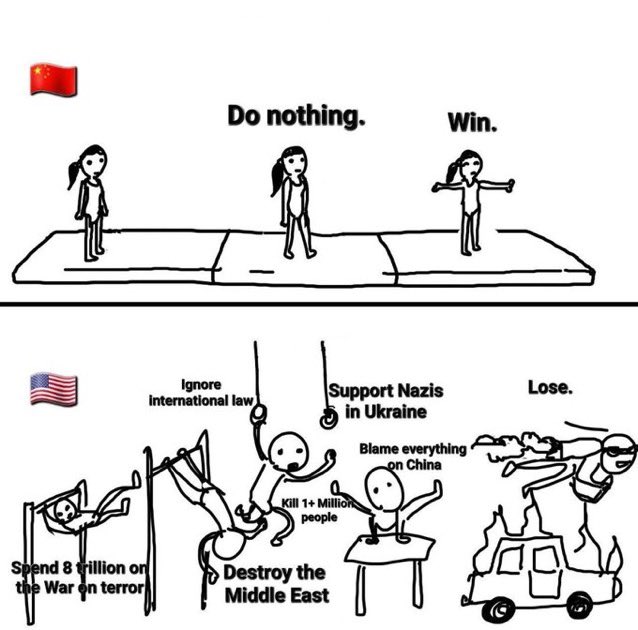
I’m sure that some of you have seen the meme of the US gymnast that engages in all manner of feats, while a Chinese gymnast does nothing and still wins. It is so very interesting to me how the current administration is manifesting this very reality.

We are learning that China’s universities are increasingly surpassing the US, which only makes sense if you consider the irrational hostility of the administration to science and its cancellation of millions of dollars in research funds. Who did this benefit?

The global energy crisis that the US and Israel have created has inadvertently created a boon for Chinese automaker BYD, the world’s largest manufacturer of electric vehicles. Bear in mind that the US government not only ended subsidies to support EV sales, but also has lowered fuel economy standards as a gift to fossil fuel companies. Was this a choice that enhanced US international competitiveness in the auto sector? Or was it instead another backwards-facing decision based on myopia?

The current administration has also attacked projects and subsidies focused on renewable energy. This is despite the fact that climate change threatens species extinction (a scientific reality which the current administration rejects). However, its short-sightedness has, once again, proved beneficial to China who has not only expanded its adoption of renewable energy, but is also a global leader in manufacturing in this domain. Is governance in the interest of the short-term profits of the fossil fuel industry in the best interest of society as a whole?

As an aside, some commentators have pointed out that while the US is run by people whose expertise lies in law and finance, China is run by engineers. If true, this is a damning insight into the kind of interests and logics which dominate systems of governance in the US given its increasingly sad outcomes.

Lastly, the US empire’s over-reliance on sanctions and use of financial coercion to sustain dollar-dominance appears to be unraveling. Not only has Iran been demanding payments in Chinese Yuan for safe passage through the Strait of Hormuz, I am now hearing that Russia is demanding Yuan from European nations who are, due to the current crisis, returning to it as a supplier. Hence, the overuse of sanctions as an instrument of coercive control led to the creation of alternative vehicles, a process which increasingly appears to be oriented towards China.

Again, China doesn’t have to invade or bomb other countries, destroy their economies or assassinate their leaders, it doesn’t even need to meddle in their elections and finance insurgents to gain power. And it is precisely because it has eschewed this path, focused on technological development, manufacturing and construction, trade, and diplomacy that it has and will continue to prevail.

The US elite, by contrast, has been driven by an insatiable desire for dominion over the world. Such power, if attained, is doomed to fall. A Mandinka proverb tells us, “Niŋ i lafitaa a bee la, i ka fo a bee le la,” that is, “If you want all, you lose all.” Not only is US power finite, as is all power, the increasingly desperate actions taken to sustain it will only accelerate its decline.
W.E.B. Du Bois on war and empire

One of the things that I noticed as I was writing my dissertation about Du Bois was his participation in the peace movement. In fact, when I was at Fisk doing research, his opposition to militarism was indelible. To be sure, he viewed war as an instrument of empire, one ultimately incapable of securing the surety of peace and human well-being. Further, war and militarism were linked to capitalism. Hence, for all its horror, warfare is exceedingly profitable.

At any rate, he might say of our present moment that humanity stands at the precipice. I agree. Militarism is increasingly the preserve of dying empires. Moribund powers whose folly will result, not only in their annihilation, but ours with it.

Read “There Is No Such Thing as a Small Nuclear War” by Tricontinental: Institute for Social Research: https://thetricontinental.org/newsletterissue/nato-ukraine-nuclear-crisis/

Trade, solidarity, or hegemony: Africa and China

A Sudanese sister who I occasionally interact with on Twitter posted something about the problems of understanding Africa-Chinese relations through a Western lens. I offered the following as a response.

The relationship between China and Africa is complex due to its longevity. Prior to the formation of Western hegemony, and extending back to the very distant past, trade relations existed between the two.

During the decolonization movement, China became an ally of African independence struggles and, more broadly, a signifier of Black revolutionary struggle even in the US.

We can consider the so-called era of globalization as the third and most recent stage of African-Chinese relations, wherein the imperatives of global capitalism and the need to counter Western hegemony has re-patterned this relationship in exploitative ways.

There are several dimensions to be mindful of. These relations have been shaped by (1) internal developments in both African & China, (2) broader regional and global dynamics, and (3) the context of global capitalism and the context of neocolonialism.

As to the issue of Chinese anti-Black racism, it should be noted that China is a multi-ethnic society and that there is a history of discrimination against non-Han groups within China such as Hakka, Uyghurs, and Tibetans. Much of this history is quite violent. In addition to this, there is evidence of negative perceptions of Africans from over a thousand years ago. Perhaps this was derived from Chinese contacts with the Arabs or domestic and pre-existing prejudice. Furthermore, there were enslaved Africans in China, but it should be noted that this was not the chattel slavery instantiated by the West centuries later.

Below are some sources for further reading:

Africans and African-Americans in China: A Long history, a troubled present, and a promising future?

BBC Eyewitness: Racism for sale

China bashes US over racism, inequality, pandemic response

China’s Second Continent: How a Million Migrants Are Building a New Empire in Africa

Everybody Was Kung Fu Fighting: Afro-Asian Connections and the Myth of Cultural Purity

Marx, Du Bois, and the Black Underclass: RAM’s World Black Revolution